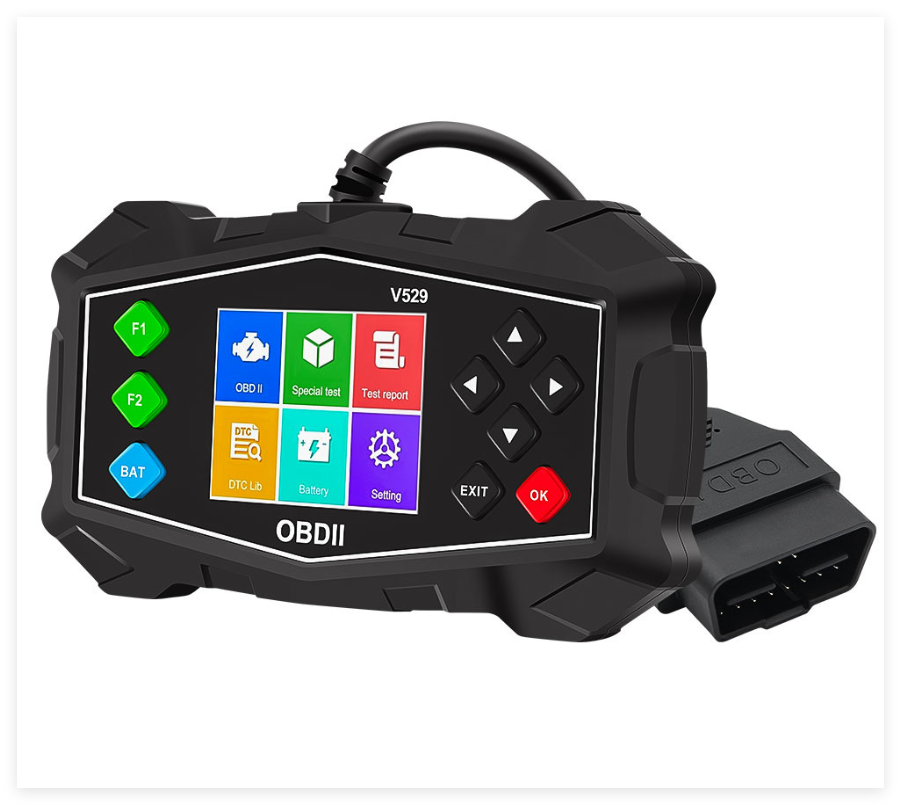
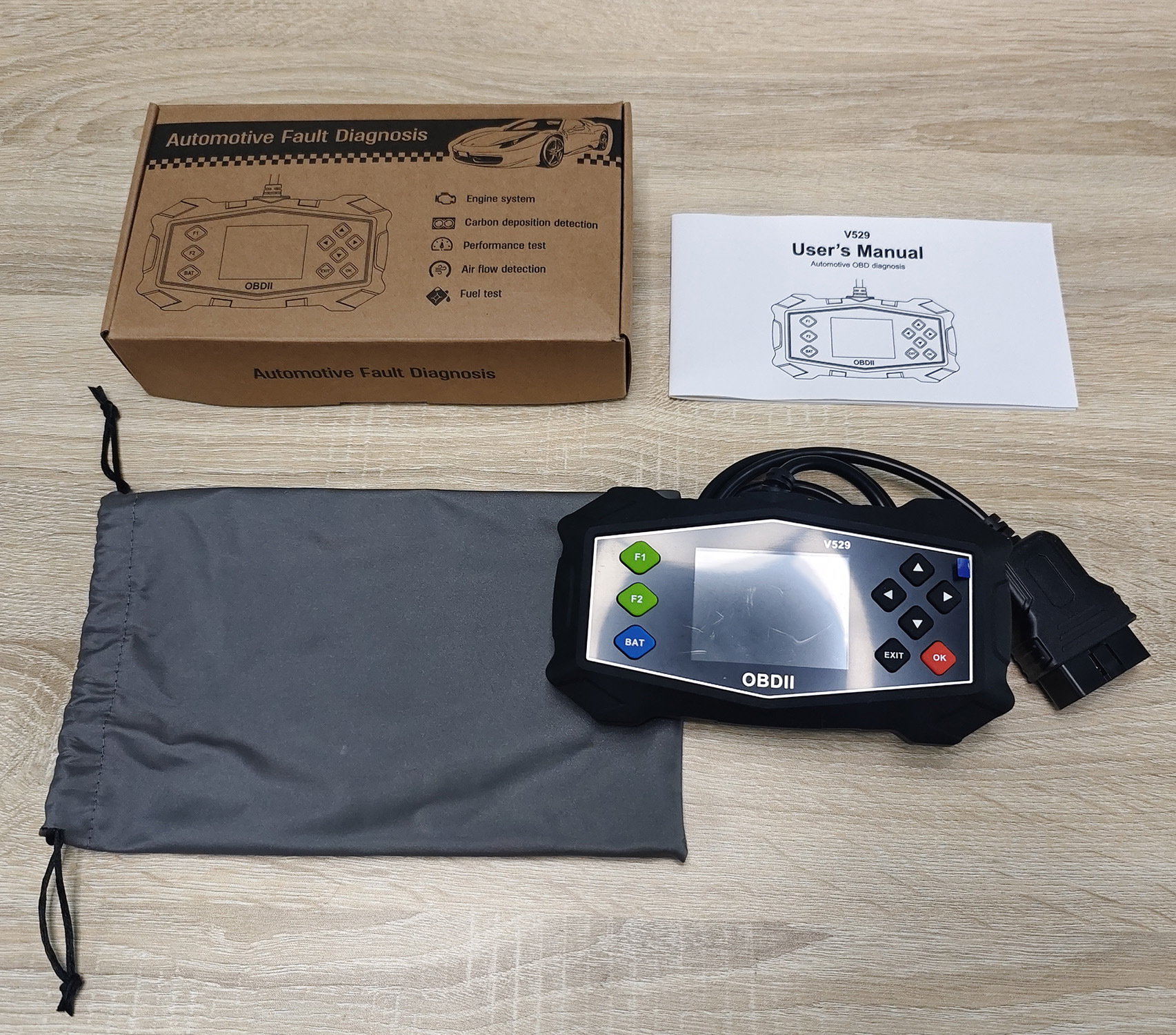
The V529 Automotive OBD Scanner is a fault diagnosis tool specifically designed for gasoline-powered vehicles. It supports 9 major standard protocols of OBD II/EOBD and features a plug-and-play design for convenience. Capable of quickly reading vehicle fault information and various parameters, it provides comprehensive and efficient diagnostic support for automotive maintenance and repair, making it a practical tool for both car owners and maintenance technicians.
I. Core Functions: Comprehensive Coverage of Diagnostic Needs
(I) Basic Diagnostic Functions
1.Fault Code Handling: It can read fault codes in the engine system and their corresponding fault definitions, supporting page-up and page-down viewing of multiple fault codes. It also enables clearing fault codes—once cleared successfully, the engine fault light will turn off; if clearing fails, you can try turning off the engine, powering it on again, and re-clearing.
2.Freeze Frame Viewing: When a fault code appears in the emission system, the vehicle’s ECU (Electronic Control Unit) automatically records snapshot data (freeze frame). This function allows reading such data to help determine the cause of the fault.
3.I/M Readiness Status Detection: Used to check the status of various vehicle monitoring items. “OK” indicates the monitoring test is completed, “ON” means it is incomplete, and “N/A” denotes the vehicle does not support the monitoring function. Each monitoring item has specific driving conditions and time requirements.
4.Vehicle Information Query: It can display key information such as Vehicle Identification Number (VIN), Calibration Identification Number, and Calibration Verification Number, facilitating understanding of basic vehicle parameters.
5.Data Stream Reading: Real-time acquisition of the engine’s current data stream information, including calculated load value, engine coolant temperature, short-term and long-term fuel trim values, etc.—a total of 356 data items—enabling dynamic monitoring of the engine’s operating status.
6.Mode 6 Detection: Focuses on detecting components related to the vehicle’s exhaust system, including exhaust sensors, catalytic converters, variable valve timing systems, exhaust sensor heating, and heated catalytic converters, ensuring the normal operation of the exhaust system.
7.Oxygen Sensor Testing: Reads oxygen sensor data to determine whether various test data are normal, covering different sensors in multiple banks. It also allows viewing details such as air-fuel ratio thresholds and sensor switching frequency.
8.Mode 8 Detection: Specifically tests for leaks in the vehicle’s fuel evaporation system, ensuring the tightness of the fuel system, reducing fuel waste, and minimizing environmental pollution.
(II) Specialized Testing Features
1.Performance Testing: Covers acceleration performance, braking performance, driving distance testing, and instrument data reading, providing a comprehensive evaluation of the vehicle’s power and control-related performance.
2.Carbon Deposit Detection: Can detect the severity of carbon deposits in the vehicle, while displaying data such as throttle opening value, coolant temperature, and engine speed to provide a basis for carbon deposit cleaning. Before testing, automatic transmission vehicles should be shifted to P (Park) gear, manual transmission vehicles to N (Neutral) gear; turn off air conditioning and other electrical equipment, and ensure the engine is idling.
3.Airflow Detection: Measures the engine’s air intake volume, helping to determine whether the engine control unit (ECU) can accurately control fuel injection quantity and ignition timing to maintain a balanced air-fuel mixture concentration in the cylinders and ensure stable engine performance.
4.Fuel Testing: Detects the vehicle’s long-term and short-term fuel trim values. These data directly affect the vehicle’s fuel consumption, power output, and emission performance, helping to optimize the working state of the fuel system.
(III) Auxiliary Practical Functions
1.Test Report Generation: Compiles the read vehicle information, fault codes, voltage, data streams, and I/M readiness status data, facilitating users’ subsequent review and reference and improving diagnostic efficiency.
2.Fault Code Query: Users can adjust the fault code number using the direction keys and press the “Confirm” key to query the corresponding fault definition, quickly understanding the fault type.
3.Battery Testing: Detects the vehicle battery’s voltage and instantaneous voltage, displays data such as voltage waveform, test start time, maximum voltage, and minimum voltage, and marks the voltage level as “Poor”, “Medium”, or “Good” to help users grasp the battery’s health status in a timely manner.
4.System Settings: Supports multi-parameter settings for the product, including switching between 12 languages (English, German, French, Spanish, Italian, Portuguese, Russian, Dutch, Polish, Japanese, Chinese, Arabic), adjusting measurement units, modifying screen contrast, controlling the buzzer on/off, and viewing product-related information.
II. Product Parameters: Stable, Reliable, and Widely Compatible
Parameter Category Specific Details
Operating Voltage:DC 9-16V
Operating Current:Approximately 37-57mA
Operating Ambient Temperature:-20~60℃
Storage Temperature:-20~60℃
Supported Languages:English, German, French, Spanish, Italian, Portuguese, Russian, Dutch, Polish, Japanese, Chinese, Arabic (12 languages in total)
Supported Protocols :
1. SAE J1850 PWM (41.6Kbaud);
2. SAE J1850 VPW (10.4Kbaud);
3. ISO9141-2 (5 baud init, 10.4Kbaud);
4. ISO14230-4 KWP (5 baud init, 10.4 Kbaud);
5. ISO14230-4 KWP (fast init, 10.4 Kbaud);
6. ISO15765-4 CAN (11bit ID, 500 Kbaud);
7. ISO15765-4 CAN (29bit ID, 500 Kbaud);
8. ISO15765-4 CAN (11bit ID, 250 Kbaud);
9. ISO15765-4 CAN (29bit ID, 250 Kbaud)